
JAIIB Paper 1 (IE and IFS) Module A Unit 2:Sectors of the Indian Economy (New Syllabus)
IIBF has released the New Syllabus Exam Pattern for JAIIB Exam 2023. Following the format of the current exam, JAIIB 2023 will have now four papers. The JAIIB Paper 1 (Indian Economy & Indian Financial System) includes an important topic called “Sectors of the Indian Economy ”. Every candidate who are appearing for the JAIIB Certification Examination 2023 must understand each unit included in the syllabus. In this article, we are going to cover all the necessary details of JAIIB Paper 1 (IE and IFS) Module A Unit 2: Sectors of the Indian Economy
Aspirants must go through this article to better understand the topic, Banker Customer Relationship and practice using our Online Mock Test Series to strengthen their knowledge of Banker Customer Relationship. Unit 2: Sectors of the Indian Economy
Sectors of the Indian Economy

Economic activities in an economy are usually classified into three major sectors, and economies achieve development via their dominance in such areas.
ROLE & IMPORTANCE OF PRIMARY, SECONDARY, TERTIARY SECTOR, QUATERNARY & QUINARY SECTORS
Primary Sector
- This sector includes all those economic activities where there is the direct use of natural resources as
- agriculture, forestry, fishing, fuels, metals, minerals, etc.
- An agrarian economy exists when the agriculture sector (one of the key sectors) provides at least 50% of a country’s national revenue and livelihood.
- Primary sector constitutes
(a)agriculture,
(b)forestry, and
(c)fishing
Secondary Sector
- Includes all economic activities that involve the processing of raw materials extracted from the primary sector also called industrial sector.
- Manufacturing, one of its sub-sectors, has proven to be the largest employer in the Western developed economies.
- An industrial economy is one, in which, the secondary sector generates at least half of a country’s national GDP and employment.
Tertiary Sector
- This sector includes all economic activities that produce services, such as education, healthcare, banking, communication, and so on.
- A service-based economy exists when this sector generates at least half of a country’s national income and livelihood.
- Along with these 3 main sectors, the quaternary and quinary sectors have been introduced. In a broader they are tertiary sector sub sectors
Quaternary Sector
- Also known as the ‘knowledge’ sector.
- Includes activities such as teaching, research, and development.
- Most important in assessing the strength of an economy’s human resources.
- The intellectual aspect of the economy is represented by the quaternary sector.
This group includes:
- Employees in office buildings,
- Elementary schools and university classrooms,
- Hospitals and physicians’ offices,
- Theatres,
- Accountancy and
- Brokerage businesses, and so on.
Quinary Sector
- Includes activities in which key choices are made.
- Includes the highest level of decision makers in governments (including their bureaucracy) and the private corporate sector.
- The number of people participating in this sector is quite small, yet they are regarded the “brain” behind an economy’s socioeconomic performance.
This group includes occupations such as
- Senior company executives,
- Government officials,
- Research scientists,
- Financial and legal advisors and others.
DIFFERENCE BETWEEN THE SECTORS
The differences in activities are the foundations of their classification. The following are some of the most significant variations.

DIFFERENT REVOLUTIONS IN PRIMARY SECTOR
- Agriculture has always been the most important industry in India.
- Traditional, subsistence and livelihood, rain fed farming, food grain oriented, and deficient in diversification and commercialisation characterise India’s agricultural sector.
- To overcome the decreased supply in recent time, the government carried out a series of revolutions in the primary sector to increase capacity. The multiple revolutions influencing agricultural production:


GDP CONTRIBUTION OF DIFFERENT SECTORS
- By the late 1990s, : India had transitioned from agricultural dominance to services supremacy, with services accounting for over half of her national GDP.
- The agriculture sector – 18% of total GDP.
- The services sector – more than 55%
- secondary sector – 27%, with only 14% coming from the manufacturing sector.
AGRICULTURE
- Most significant sector in India.
- Not only the largest sector, but also the biggest private sector.
- Main unorganised sector of the economy, accounting for more than 90% of all unorganised labour
- (93.4% of the total labour force of the economy, i.e., 40.0 crore is employed in the unorganised sector).
- Agriculture’s share in gross income has been declining, while the industrial and service sectors’ shares have been steadily increasing.
Agriculture has recently had satisfactory development as a result of:
- improved technology,
- irrigation,
- inputs, and
- pricing strategies
- In recent years, livestock, poultry , fisheries, and horticulture have led the way in terms of output increase.
- Despite all these structural changes, agriculture remains a critical sector, offering employment and livelihood opportunities to a large segment of the population.
- Government of India Report of 2020-21 by Ministry of Agriculture & Farmers’ Welfare
- “Agriculture plays a vital role in India’s economy.
- 6% of the total workforce is engaged in agricultural and allied sector activities (Census 2011) and accounts for 17.8% of the country’s Gross Value Added (GVA) for the year 2019-20 (at current prices).
- Given the importance of the agriculture sector, Government of India has taken several steps for its development in a sustainable manner.
- Steps have been taken to improve the income of farmers.
- Further, to mitigate risk in the agriculture sector, a scheme ‘Pradhan Mantri Fasal Bima Yojana’ (PMFBY) was also launched in 2016.
- Schemes such as Formation & promotion of 10,000 FPOs & the Agriculture Infrastructure Fund have also been launched recently to benefit the sector.”
As per the Land Use Statistics 2016-17

- Agriculture Gross Value Added (GVA): As per the provisional estimates of Annual National Income released by Central Statistics Office (CSO), Ministry of Statistics & Programme Implementation, the agriculture and allied sectors contributed approx 17.8% of India’s GVA at current prices, during 2019-20, marginally higher than 17.7% in 2015-19.
INDUSTRY
- The industrial sector is equally vital, since it promotes
- Economic growth,
- Provides self-sufficiency and employment,
- Generates demand for agricultural commodities and produces a ‘ripple effect
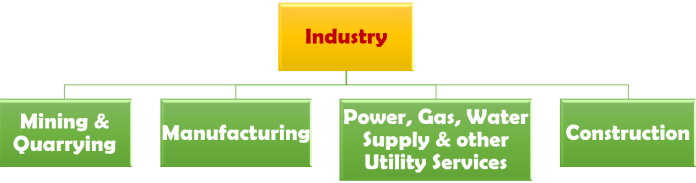
- Manufacturing = Around 18% of total gross value added (GVA),
- construction = Around 8% of total GVA.
- Mining and quarrying, as well as power, gas, water supply, and other utility services = Approx 3% and 2% respectively.
- Industry’s share of GVA has increased
- 1950-51 : nearly 17%
- 2021-22 : 29%
The journey of Indian industry can be summed up into 4 phases including both pre-reform and post-reform period.

- IIP : The Index of Industrial Production (IIP) measures the change in volume of production in a given year (base year 2010-11).
- It is an index reflecting growth in the broad sectors of mining, manufacturing and electricity and also the growth in use-based sectors of basic goods, capital goods and intermediate goods.
- Calculated by the National Statistical Office which also calculates the Index of Core Industries (ICI).
8 Core industries:
- Refinery
- Products
- Electricity,
- Steel,
- Coal,
- Crude oil,
- Natural gas,
- Cement
SERVICES
- The sector produces ‘intangible or invisible goods’ for businesses as well as consumers, Trade, repairs, hotels & restaurants, transport, storage, communication & broadcasting services, railways, road transport, water transport, air transport, services incidental to transport, storage, financial, real estate, and professional services are all sub-sectors of the services sector.
- Financial services, real estate, property ownership, and professional services, communal, social, and personal services, government administration and defence, and other services are all a part of the services.
- The services sector’s proportion has increased from 33% in 1950 to 53% in 2021-22.
- As per Government of India publication, chapter 9 of Union Budget 2019-20 –
- “The services sector accounts for 54% of India’s Gross Value Added (GVA).
- Its growth rate moderated to 7.5% in 2018-19 from 8.1% in 2017- 18.
- The segments that saw deceleration are tourism, trade, hotels, transport, communication and services related to broadcasting, public administration and defence.
- Financial, real estate and professional services category accelerated.
- An important finding is that India’s services sector does not generate jobs in proportion to its share in GVA.
- Foreign Tourist: 2017-18 : 10.4 million
- 2018-19 : 10.6 million
- Foreign exchange earnings from tourism in India
- 2017-18: US$28.7 billion
- 2018-19: US$27.7 billion
- Many of the high frequency indicators, such as bank credit to services sector, decelerated in 2018-19.
- However, the IT-BPM industry grew by 8.4% in 2017-18 (US$167 bn) & is estimated to have reached US$181 bn in 2018-19”.
As per the findings of the Ministry of Statistics and Programme Implementation (MoSPI), in the year 2019-20
- As per the World Investment Report 2021 by the UN Conference on Trade and Development (UNCTAD), India in 2020 was the 5th largest recipient of FDI.
- India has made a global impact by being amongst the top ten service exporter countries.
- India’s and Indians dominance in Software is globally respected. Of the total net Service Exports, about 40% pertains to Software.
Employment Growth Rate In Secondary Sector

- Manufacturing employs roughly 12% of the labour force.
- Known throughout the world for creating mass employment for low-skilled workers in the modern economy.
- With agriculture’s capability to provide jobs rapidly dwindling and the modern services sector’s limited ability to absorb relatively unskilled labour displaced from agriculture, hopes are that the manufacturing sector will generate mass employment.
- The construction sector : 2nd largest employment sector in the country, only after agriculture.
- Construction activity is an essential component of a country’s industrial and infrastructure growth, as well as a key input for socioeconomic development.
- This sector provides significant employment and growth input to other sectors via backward and forward linkages.
- Cement, steel, bricks, tiles, sand, aggregates, fixtures, fillings, paints & chemicals, construction equipment, petro-products, timber, mineral products, metal, glass, and plastics are all important components of the construction industry.
- The Indian construction sector is an important element of the economy, and it is positioned for strong expansion as a result of industrialisation, urbanisation, and economic development, as well as people’s aspirations of higher living standards.
- The construction industry employs over 31 million people and accounting for around 8% of total employment.
SUNRISE SECTOR OF INDIAN ECONOMY
- A sunrise sector is one that is still in its infancy, but has the potential for significant growth.
- CHARACTERISTICS:
- strong growth rates,
- a high degree of innovation,
- a high level of public awareness, with investors attracted to its long-term growth prospects.
Existing Indian industries that may be categorised as Sunrise sectors are likely to benefit the economy in terms of job creation and business growth, in the future.
-
- Green Energy,
- Fintech, Information Technology,
- Electronics,
- Pharmaceuticals,
- Automobiles,
- Healthcare,
- Infrastructure Sector,
- Retail Sector,
- Processing Plants,
- and other emerging sectors of the Indian economy
ORGANISED AND UNORGANISED SECTORS
- Organised Sector : where the job terms are fixed and regular, and the employees are guaranteed work and social security
- Comprises : Manufacturing, enterprise, business, school, hospital, and unit registered with the government.
- Also comprises legally licenced stores, clinics, and offices.
- Lower unemployment than the unorganised sector.
- Unorganised sector: where employment terms are not defined and regular, and enterprises are not registered with the government.
- Construction workers, domestic workers, street workers, and those operating in tiny workshops unaffiliated with the government are all part of the unorganised sector.
- A home-based worker, self-employed worker or wage worker in the unorganised sector is an unorganised worker.
- Characteristics: Low wages, unstable and irregular work, and a lack of protection from legislation or trade unions Relies heavily on labour and indigenous technologies.
- According to the NCEUS (National Commission for Enterprises in Unorganised Sector) categorisation, “the unorganised sector comprises of all unincorporated private enterprises owned by individuals or households engaged in the sale and production of goods and services operated on a proprietary or partnership basis and with fewer than ten total workers.”
- However, “informal workers” are defined as “those who work in unorganised firms or families, excluding regular workers with social security benefits, and workers in the formal sector who do not get any employment benefits/social security from their employers.”
Difference between Organised and Unorganised sectors
| BASIS FOR COMPARISON | ORGANISED SECTOR | UNORGANISED SECTOR |
| Meaning | The sector in which the employment terms are fixed and employees have assured work is Organised sector. | The sector that comprises of small scale emterprises or units and are not registered with the government. |
| Governed by | Various acts like Factories Act, Bonus Act, PF Act, Minimum Wages Act etc. | Not governed by any act. |
| Government rules | Strictly followed | Not followed |
| Remuneration | Regular monthly salary. | Daily wages |
| Job security | Yes | No |
| Working hours | Fixed | Not fixed |
| Overtime | Workers are paid remuneration for overtime. | No provision for overtime. |
| Salary of workers | As prescribed by the government. | Less than the salary prescribed by the government. |
| Contribution to Provident fund by the employer | Yes | No |
| Increment in salary | Once in a while | Rarely |
| Benefits and perquisites | Employees get add-on benefits like medical facilities, pension, leave travel compensation, etc. | Not provided. |
Unit 2 Sectors Of the Indian Economy( Ambitious Baba ) PDF
- Join Telegram Group
- For Mock test and Video Course Visit:ambitiousbaba.com
- Join Free Classes: JAIIBCAIIB BABA
- Download APP For Study Material: Click Here
Buy JAIIB MAHACOMBO 2023


